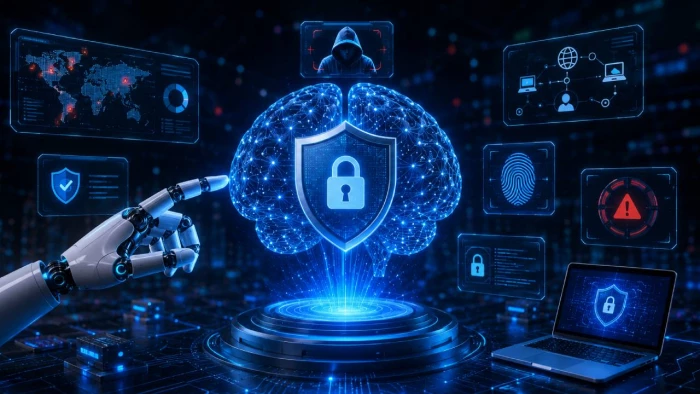
It has always been a tale of the "good guys vs. the "bad guys. Whenever security teams discover a way to block a threat, they have a response to find another way around. Each time security teams come up with some way to counteract a threat, cybercriminals come up with a plan to get around it. In recent years, it is the pace of that race that's changed.
Artificial Intelligence makes a significant contribution to both sides now. With A, I attacks can be more believable, attacks can be automated,d and vulnerabilities can be revealed sooner. As a result, the security sector is putting to use the capabilities of AI technology to predict potential threats faster, process vast amounts of data, and to take precautionary steps to stop a problem from occurring and causing significant damage.
Numerous threats are being reported more frequently, there are more devices than ever to secure, and there is more online activity than ever to monitor. There simply is too much to process by human analysts. AI can do that by identifying patterns and red flags that may otherwise remain undetected.
With businesses shifting more and more towards an online operating model, AI is one of the most valuable tools available in today's cybersecurity repertoire.
Many security systems had pre-determined rules a couple of years back. If it was a threat that was similar to a pattern, it was blocked. If it did not look differently it could certainly go unnoticed.
The modern-day cyber attack is far more dangerous. Traditional systems are difficult to detect suspicious activities due to the changes hackers make in their methods.
AI aids with information processing, which would otherwise be too time-consuming for humans. It does not just look for known attack signatures, but can detect abnormal behavior,r which can warn of new types of attacks.
Advanced security technologies are a focus of numerous organizations, including the NIST, which is still emphasizing its need to address the increasing cyber risks faced by organizations.
AI enables better threat detection. AI's ability to detect patterns is one of the primary benefits.
A lot of applications produce tons of network traffic and network activity daily. There could be clues to phishing, malware infections, unauthorized access, or threats from inside the organization in that data.
Phishing is still widely seen as a type of cyber attack all over the world. The attackers are now trying to get more convincing emails via AI tools. The messages are frequently disguised as those from known brands, work colleagues, or financial institutions.
Luckily, security teams are taking a stand against AI. Email security solutions used today monitor for suspicious links, writing styles, email sender information, and behavior. AI might detect potential issues that users might not be able to detect.
Phishing is still one of the most common triggers of data breaches, according to guidance from CISA, and it's even more critical to get it early.
The sophistication of phishing attacks is also continually growing, and the rise of artificial intelligence tools to protect against them is equally valuable.
Increasingly more companies are turning to cloud platforms to store, collaborate, and work with. Cloud deployment has flexibility with security problems. Organizations have to safeguard information that's sensitive across multiple environments.
One of the major roles of AI in the field of cloud security is to continuously track and detect any irregular activities. Several cloud security tools employ machine learning to identify malicious user behavior, suspicious attempts to access the cloud, and possible data breaches.
In the ever-expanding cloud space, the Cloud Security Alliance continually reminds us of the value of intelligent monitoring. Unless automated, handling cloud security at scale becomes very challenging.
Defenders are not the only ones leveraging AI; attackers are too. Cybercriminals can leverage AI for attack automation, generating believable phishing content, and enhancing their social engineering attacks.
Another issue that is growing is deep fake technology. Imprisonment of executives, employees, and trusted contacts by fake audio and video recordings. Due to the high level of convincing replication of communication styles, voice,s and looks and feel of AI, these attacks are becoming more and more believable.
This poses new problems for businesses looking towards identity verification and fraud prevention.
But others are afraid of the backlash of AI taking over the role of cybersecurity experts. That is unlikely. Although AI is great at processing data, it is still essential that humans have a say.
Security practitioners need to analyze results, look into complex incidents, and take strategic decisions. AI is not an end-to-end entity; it does not take the place of any professional. AI should be viewed as a tool, a helping tool, not an end-to-end entity.
The best security programs that I've seen are a mixture of human mentality and intelligent automation. Machines can pick out patterns, but it takes a very skilled analyst to give a "sounding" and make judgments that a machine cannot do as well.
This balance is growing ever-more critical with threats that keep changing.
Cybersecurity changes quickly. New attacks have emerged annually, and companies need to be aware of them in order to prevent them from being successful.
Many industry experts have sources that they trust, like industry reports, government alerts, and well-known cybersecurity publications. Resources such as Cybernews provide for security professionals and business leaders to keep up with new threats, privacy issues, and new security technologies.
Being able to access accurate information is often among the very best approaches to beefing cyber security knowledge.
AI is impacting cybersecurity in numerous ways. It can facilitate quicker threat detection, better incident response, enhanced cloud security, and handling the escalating amount of security information.
As the cybersecurity landscape continues to evolve, the ability of businesses to integrate AI's features with human involvement will be crucial for the future of the industry. Companies that can leverage intelligent security solutions and generally have good levels of security awareness will be in a significantly better place to defend against the threats of today's cyber world.
My impression of the trend of AI in cybersecurity is a great way to find a faster way to discover and detect cyber threats than the traditional tools that people have. It is always monitoring activity on the network and will mark any that seems "normal" activity and "alert" the security personnel if such is found. The landscape of cybercrime is continually changing,g and AI is helping businesses to “see” through all this information in mere seconds and be proactive about it.
From threat detection and security monitoring to automated responding to incidents, AI's application in cybersecurity is multifaceted. It boasts among its many strengths speed. In many cases,s it can quickly learn information and determine whether there exists any dangers or not before it actually occurs.
AI can prove to be very effective in detecting phishing. It analyzes emails, links, attachments, and even pattern files to see if an email is considered true or false.Server Learning: When it involves utilizing e-mail, exposure may be lowered since the AI understands the indications and characteristics of phishing e-mails.
Share your thoughts about this article.
Be the first to post a comment!

The best AI image generator in 2026 is Nano Banana 2 for speed, FLUX.2 for photo...
Techie Frog5 days ago

Artificial intelligence will be used in learning in the future. At present, lear...
Terri Cruz4 months ago

Photos in the modern digital age have become a very important aspect in communic...
Kruzel7 months ago
Have you ever had to call a bunch of people and say the same thing over and over...
Kruzel9 months ago
In a world dominated by digital imagery, old photographs often hold a sentimenta...
Terri Cruz1 year ago
As businesses scale, so do their customer service demands—and traditional suppor...
Kruzel1 year ago